THEORETICAL ASTROPHYSICS

Why do galaxies and plasmas evolve as they do?

I’m Uddipan Banik, a theoretical astrophysicist and Yakov B. Zel’dovich Fellow at the Perimeter Institute for Theoretical Physics. I use analytical theory and numerical simulations to study the non-linear relaxation of galaxies and dark matter halos, and astrophysical plasmas ranging from stellar interiors to accretion disks around black holes. I am intrigued by how universal scaling relations emerge in seemingly complex environments.

Zel’dovich Fellow, Perimeter Institute for Theoretical PhysicsVisiting Scientist, Plasma Science and Fusion Center, MITFormer Member, Institute for Advanced StudyFormer Postdoctoral Fellow, Princeton UniversityPhD, Yale University · 2023BS Physics, IIT Kanpur · 2017
SCROLL TO DISCOVER
01 / ABOUT

About my research.

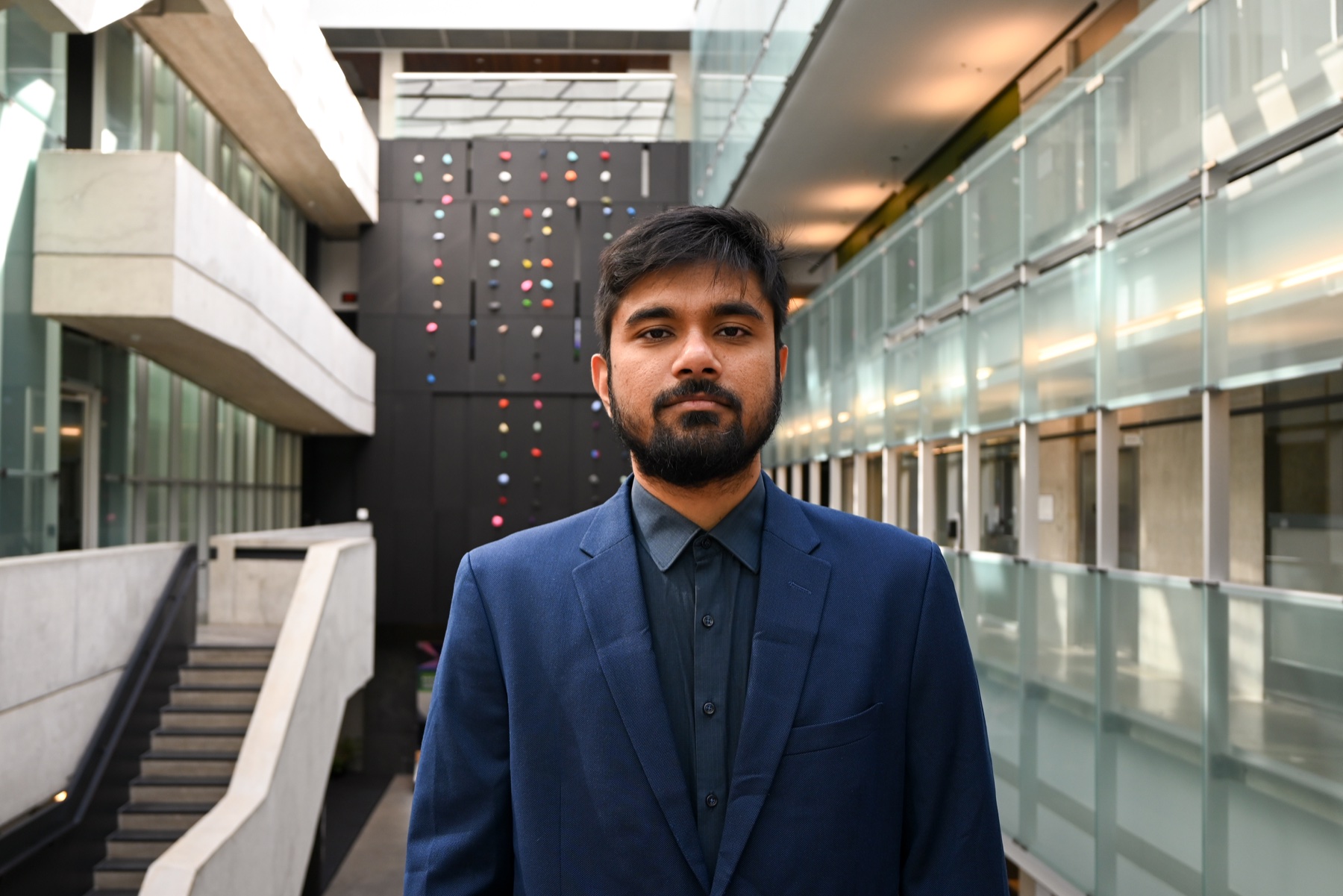
Portrait of Uddipan BanikUddipan Banik · Perimeter Institute for Theoretical Physics

My research spans the dynamics of galaxies, dark matter halos and plasmas. I study how gravity and electromagnetic forces drive the relaxation of many-body astrophysical systems.

At Yale, I developed kinetic theories of dynamical friction and phase-space spirals in galaxies. My postdoctoral work explains the formation of dark matter halo profiles and non-thermal particle distributions, and investigates the origin of magnetic cycles in the Sun and accretion disks.

See the research themes
02 / RESEARCH

Research areas.

During my PhD, I studied how gravitational perturbations reshape galaxies. My postdoctoral research uses kinetic theory to study dark matter halo profiles and particle acceleration in plasmas, and MHD to investigate magnetic-field generation and cycles in the Sun and accretion disks.

01PHD RESEARCH · YALE UNIVERSITY

Galaxies &
dark matter.

In my PhD research, I developed theories of how galaxies and dark matter halos respond to gravitational perturbations. I studied how encounters with satellite galaxies generate phase-space spirals in stellar disks and how resonant orbits drive dynamical friction, buoyancy, and core-stalling.

Galactic dynamicsPhase-space spiralsDynamical frictionDark matter halos
02POSTDOCTORAL RESEARCH

Dark matter, plasmas &
dynamos.

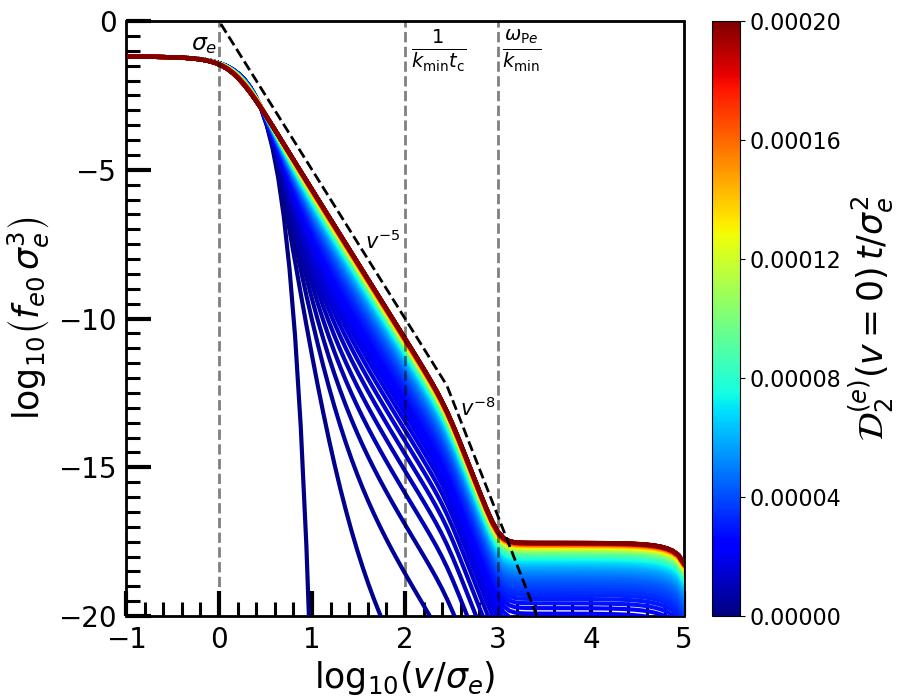
My postdoctoral work uses kinetic theory to study the origin of universal dark matter halo profiles and non-thermal particle acceleration in collisionless plasmas, and MHD to understand how large-scale magnetic fields arise and self-organize in the Sun and accretion disks.

Kinetic theoryHalo cusp formationMRI dynamosSolar magnetism
POSTDOC / 02

Quasilinear halo relaxation ↗

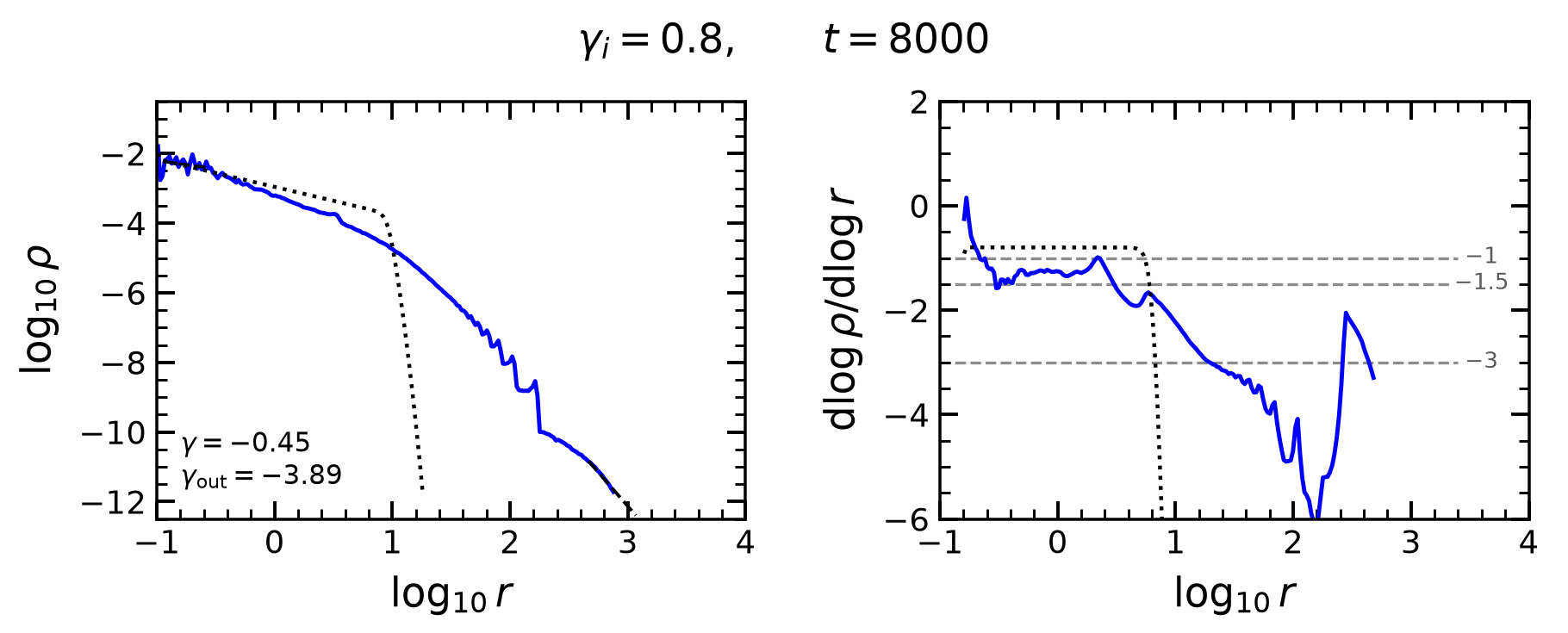
Kinetic theory asks why collisionless dark matter halos can approach familiar density profiles.

Physical Review D · 2025
ONGOING / 03

Dark matter halo profiles ↗

Boltzmann–Poisson theory connects collapse, accretion and substructure to prompt cusps and halo profiles.

Submitted to Physical Review D
SOFTWARE / 08

VENUS numerical solver ↗

A kinetic-gravity computational laboratory for dark matter evolution and relativistic collapse.

Ongoing software
Explore all research themes
03 / RESEARCH IN MOTION

Research in motion.

Figures and simulations from my papers, ongoing projects, and research talks. Select a visual to see the full result.

04 / WRITING

Publications & preprints.

Selected submitted manuscripts, refereed papers, codes, and work in preparation are listed below.

Submitted manuscripts

First author refereed publications

Co-authored refereed publications

Codes

  • “VENUS”: Vlasov-Einstein NUmerical Solver code in C++ (OpenMP & MPI parallelized, GPU-accelerated), equipped with Einstein-Vlasov, Einstein-Boltzmann, Vlasov-Poisson and Boltzmann-Poisson (CDM and SIDM) modules, for the numerical simulation of non-linear structure formation (virialized halos and black holes) in weakly collisional self-gravitating systems.
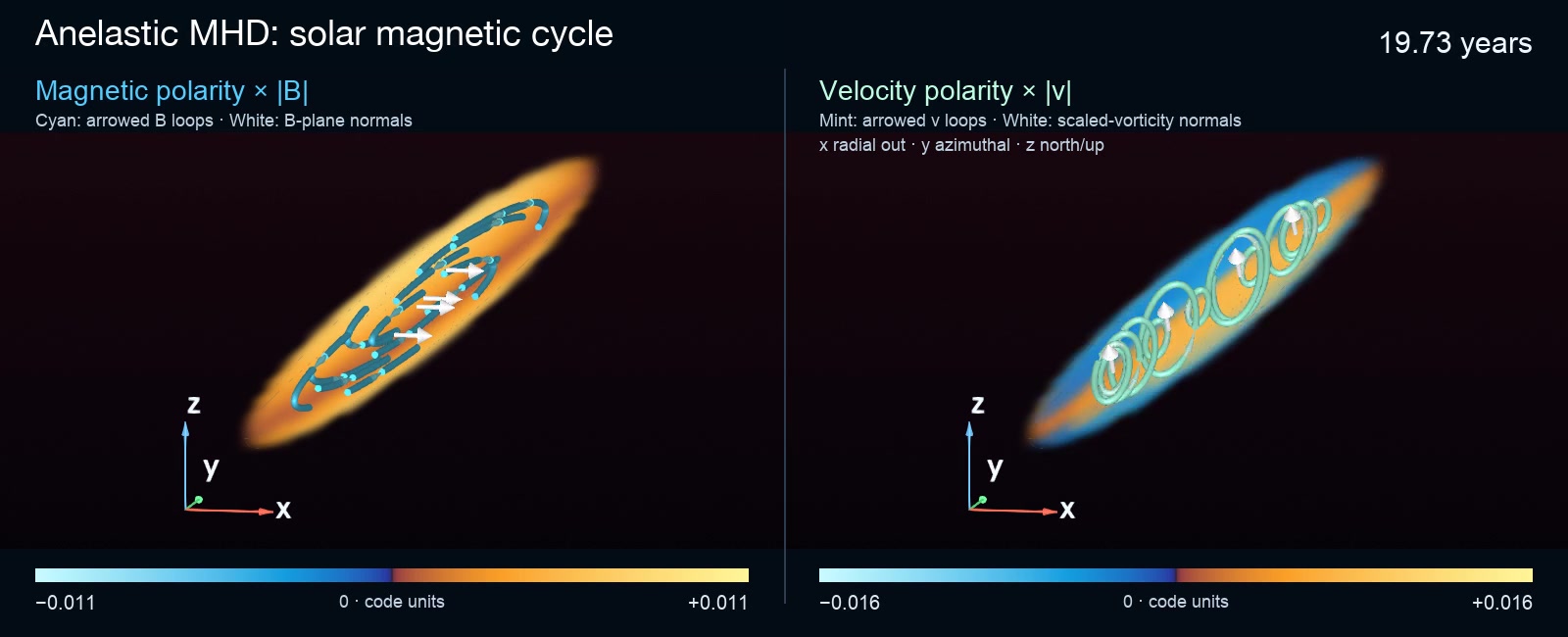
  • “Stellar dynamo solvers for AthenaK and Athena++”: Developed an anelastic MHD solver in AthenaK and Athena++ for stratified, shearing simulations and used it to simulate a solar dynamo with sustained magnetic polarity reversals and meridional circulation resembling solar observations. Developing a fully compressible low-Mach MHD solver in AthenaK for stratified magnetoconvection.
  • “QKIN”: Quantum KINetic Solver code in C++ (OpenMP & MPI parallelized) for evolving many-body quantum states, with the aim to investigate the relaxation of weakly coupled bosonic and fermionic systems (e.g., degenerate fermions in compact objects, dilute plasmas) towards thermal and non-thermal steady states.
  • “NP-impulse”: Publicly available code in Python to compute the (non-perturbative) energy transfer and mass loss in impulsive encounters of galaxies and dark matter halos

Publications in preparation

  • “Self-similar profiles in Einstein-Vlasov systems: from virialized halos to black holes”
    Uddipan Banik, Scott Tremaine, Frank C. van den Bosch, Sachiet Kapur and Kaushik Bhattacharya
  • “Numerical solution to the Einstein-Vlasov system in spherically symmetric gravitational collapse”
    Uddipan Banik, Sachiet Kapur, Kaushik Bhattacharya, Frank C. van den Bosch and Scott Tremaine
  • “Numerical solution to the Einstein-Boltzmann problem: core-collapse and black hole formation in self-interacting dark matter”
    Uddipan Banik, Frank C. van den Bosch, Chris Hamilton, Abdelaziz Hussein, Lina Necib, Scott Tremaine, Sachiet Kapur and Kaushik Bhattacharya
  • “A self-consistent quasilinear theory for non-thermal particle acceleration in magnetized plasmas”
    Uddipan Banik, Robert J. Ewart, Alexander A. Schekochihin and Amitava Bhattacharjee
  • “How fast do supermassive black hole binaries form in galaxy mergers?”
    Kavish Sardana, Uddipan Banik, Shashank Dattathri and Frank C. van den Bosch
  • “Dynamical Friction, Buoyancy and Core-Stalling. II. Inspiral vs libration”
    Kavish Sardana, Uddipan Banik, Shashank Dattathri and Frank C. van den Bosch
  • “Self-gravitating response of galactic disks and the Gaia snail”
    Chris Hamilton, Uddipan Banik and Shaunak Modak
View ORCID researcher record
05 / PRESENTATIONS

Selected talks.

Public recordings and talk pages from recent research presentations.

Watch Perimeter talk
2026

How dark matter halos get their cusps

Perimeter Institute · September 29, 2026 · recording

↗
2026

How do plasmas and galaxies relax to (near) universal equilibria?

TIFR Astronomy and Astrophysics Seminar · February 11, 2026

↗
2023

Kinetic theory of collisionless self-gravitating systems

Perimeter Institute · July 10, 2023

↗
2022

Pushing the frontiers of gravitational encounters and collisionless dynamics

Perimeter Institute · November 22, 2022

↗
06 / CURRICULUM VITAE

Academic record.

My current CV includes publications, software, research interests, appointments, talks, and teaching.

Download CV (PDF)
CURRENTYakov B. Zel’dovich Fellow, Perimeter Institute for Theoretical PhysicsWaterloo, Canada · since September 2026
2023–2026Bezos Member, Institute for Advanced StudySchool of Natural Sciences
2023–2026Postdoctoral Fellow, Princeton UniversityMulti-Messenger Plasma Physics Center
CURRENTVisiting Scientist, MIT Plasma Science and Fusion CenterSince 2025
2023PhD in astrophysicsYale University
2017BS in physicsIIT Kanpur
HONORSYakov B. Zel’dovich Fellowship2026 · Perimeter Institute
HONORSDirk Brouwer Memorial Prize2024 · Yale University
HONORSTinsley Prize2022 · Yale University
07 / CONTACT

Get in touch.

For research discussions, seminars, or collaborations, please email me.

ubanik@perimeterinstitute.ca