RESEARCH / FIELD NOTES

How do complex astrophysical systems organize and evolve?

I study how self-gravitating systems and plasmas relax, using kinetic theory, hydrodynamics and numerical simulations.

POSTDOCTORAL RESEARCH

Postdoctoral research.

SOLAR MAGNETISM

What sustains the solar magnetic cycle?

The Sun reverses its large-scale magnetic polarity approximately every 11 years. What sustains these reversals, and why is the period so much longer than the solar rotation period?

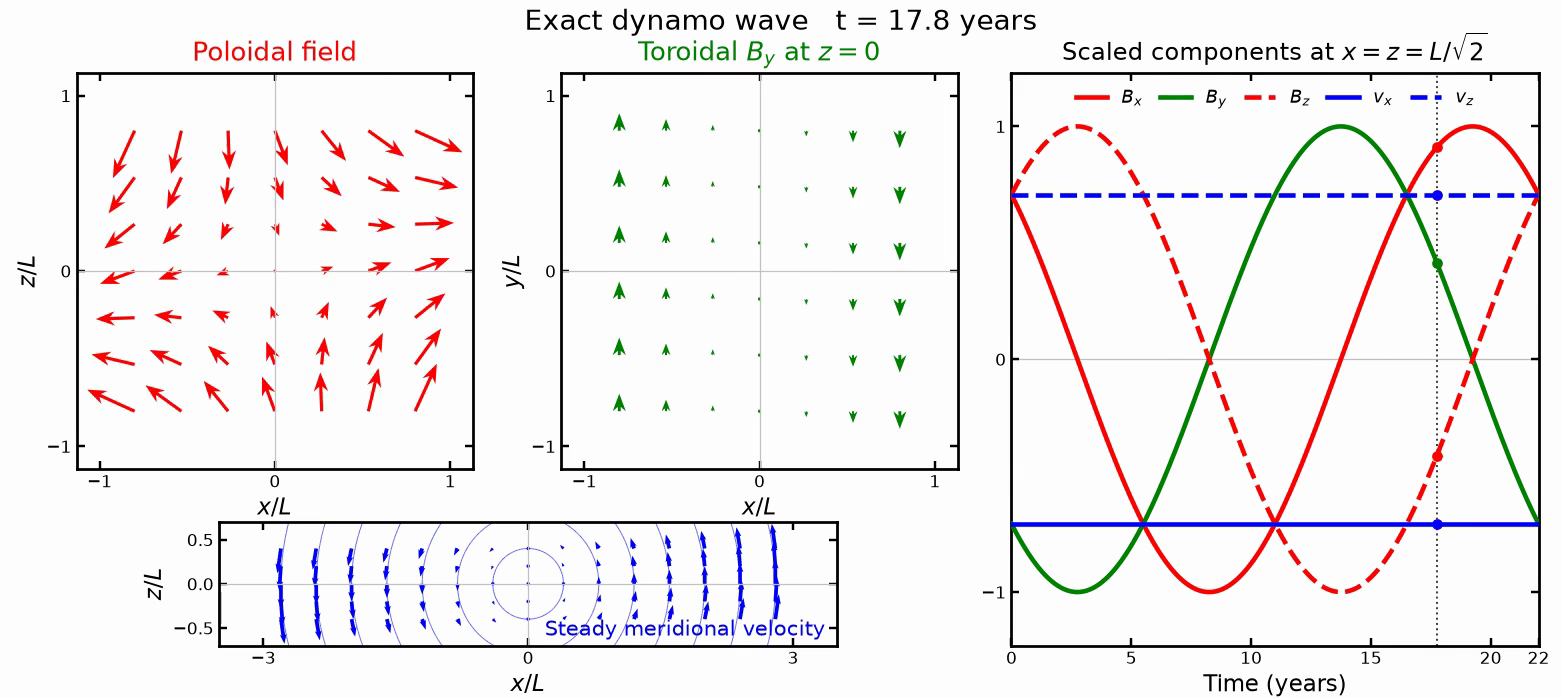
In a preprint submitted to Physical Review E, I derive exact non-linear magnetohydrodynamic solutions in a rotational shear flow. Circulation turns the poloidal field; shear generates the toroidal field; magnetic tension and Coriolis deflection alter the shear flow and circulation. This cycle supports a dynamo wave that reverses its magnetic components over many rotation periods. I also use anelastic MHD simulations in AthenaK to study sustained magnetic reversals and meridional circulation resembling solar observations. I am also developing a fully compressible low-Mach MHD solver for stratified magnetoconvection.

  1. Circulation turns the poloidal field.
  2. Shear stretches it into a toroidal field.
  3. Magnetic tension and Coriolis forces act back on the flow, continuing the cycle.

The analytical solution describes a dynamo wave in a shear flow; the anelastic MHD simulation follows magnetic reversals and circulation in a stratified, shearing solar box.
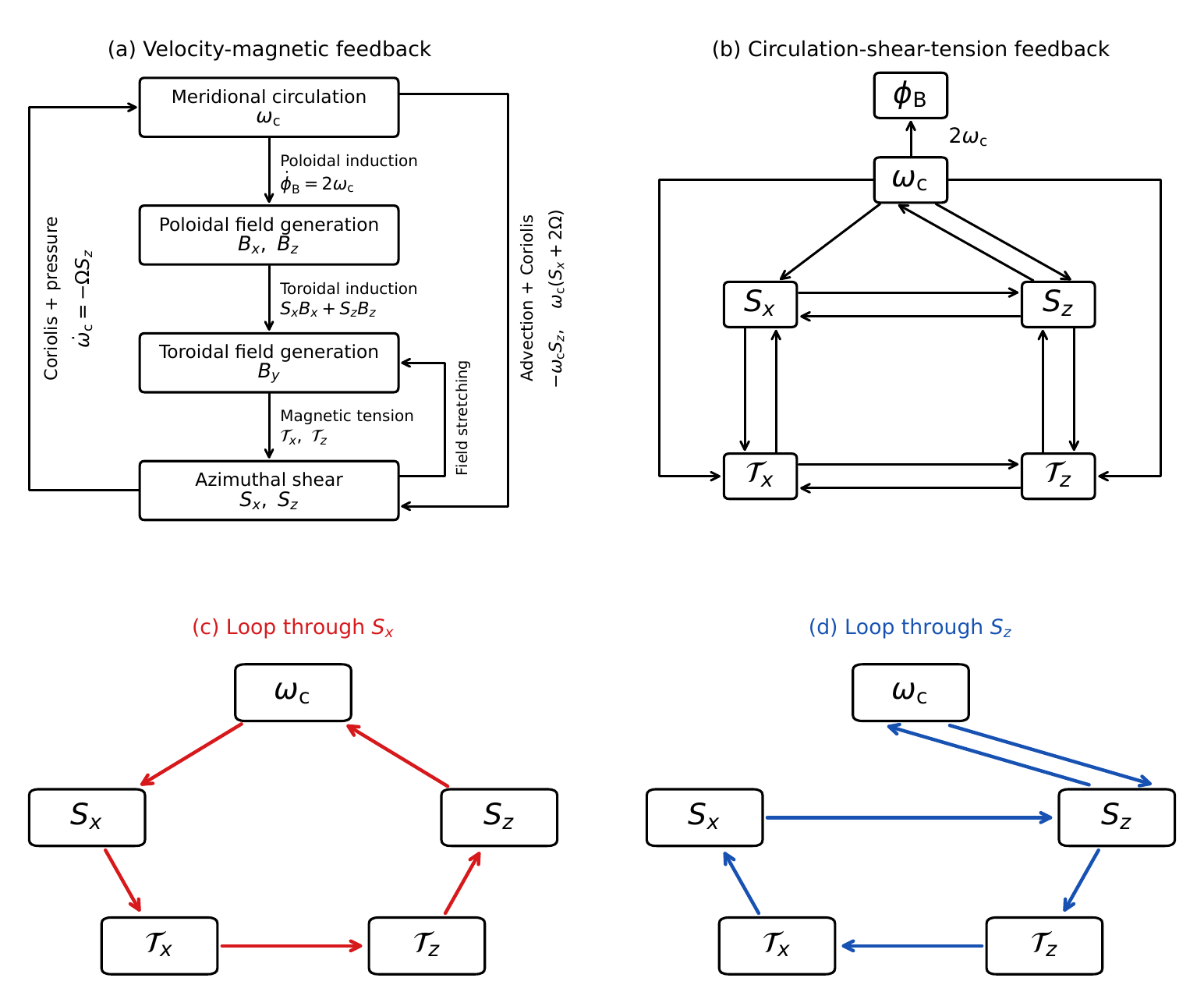
Four-panel paper diagram of the magnetic-cycle feedback: circulation generates a poloidal field, shear generates a toroidal field, and magnetic tension feeds back on the flow through two routes
How the cycle works. The paper’s feedback diagram traces how meridional circulation, shear, induction, and magnetic tension act together to sustain steady magnetic reversals. Red and blue mark two routes for the cyclic dynamo.
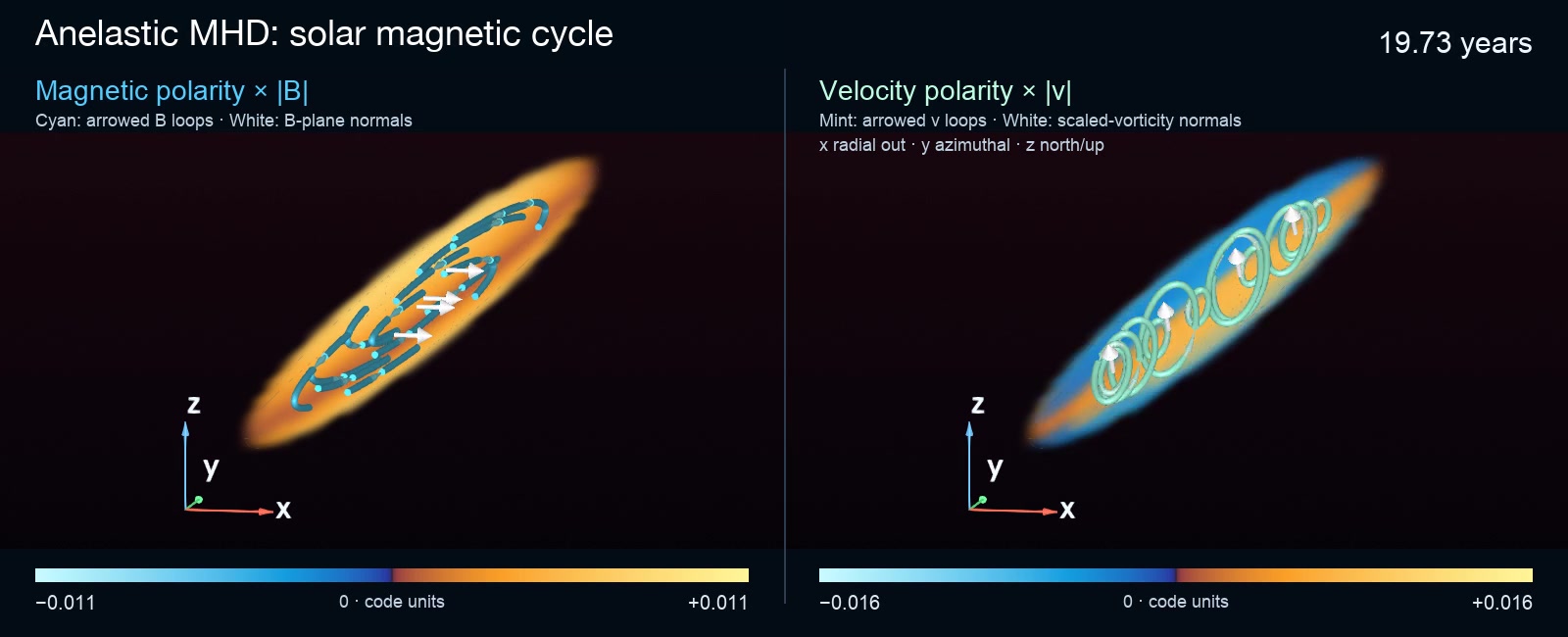
The cycle in motion. My October 2026 dynamo-talk animation shows the magnetic field B and velocity field v variations through a full 22-year (11-year reversal) magnetic cycle. View the original GIF ↗
Solar dynamo simulation. Magnetic field and velocity evolve through a modeled 11-year cycle in an anelastic MHD calculation. The poster shows a late phase of the cycle.
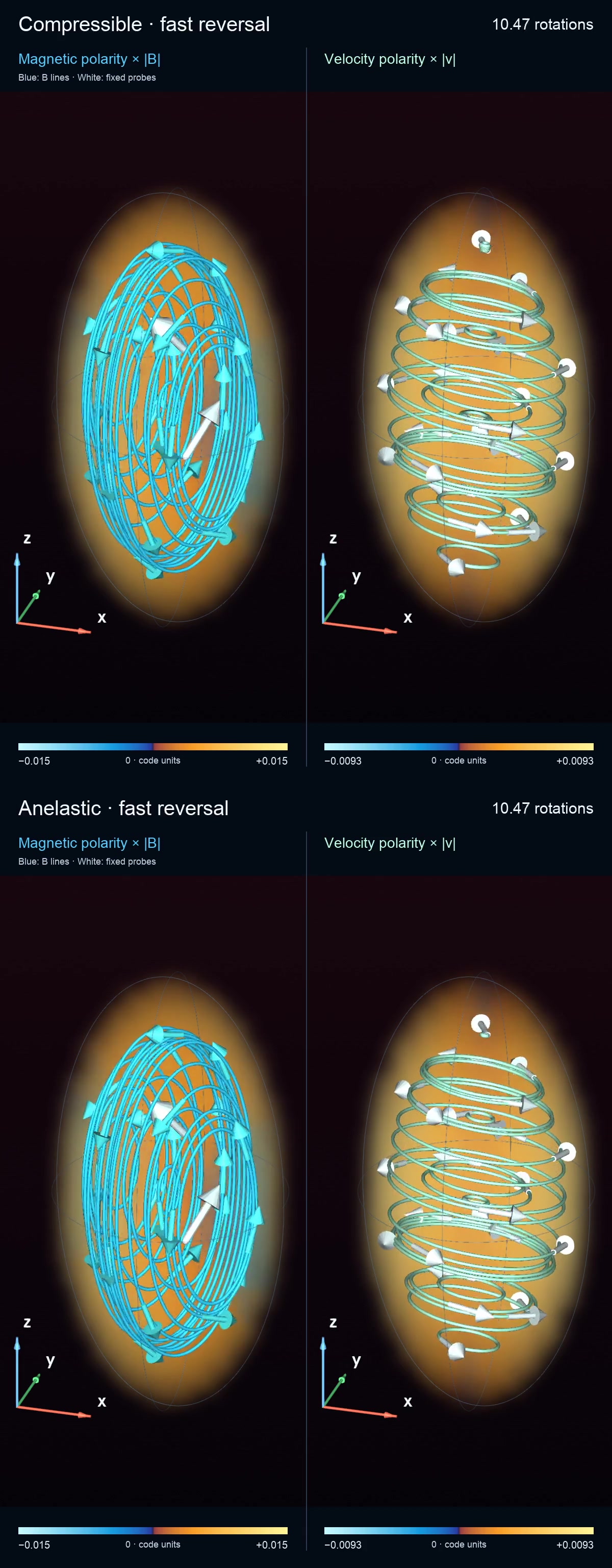
Fast-reversal comparison. The upper and lower rows show compressible and anelastic simulations; each row displays the magnetic field and velocity through the same sequence of rotations.
ACCRETION DISKS

What drives magnetic cycles in accretion disks?

Magnetic activity in accretion disks can organize into slow, repeated cycles.

With Amitava Bhattacharjee and James Stone, I study cyclic magnetorotational dynamos using weakly non-linear theory and local shearing-box simulations. Our wave-interference paper is under review at Physical Review Research.

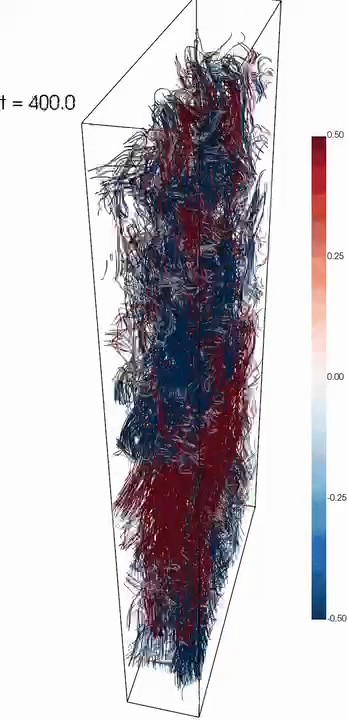
Magnetic field streamlines evolve through an MRI dynamo simulation (latest finished local movie, February 2026). Select the preview to watch the full sequence.
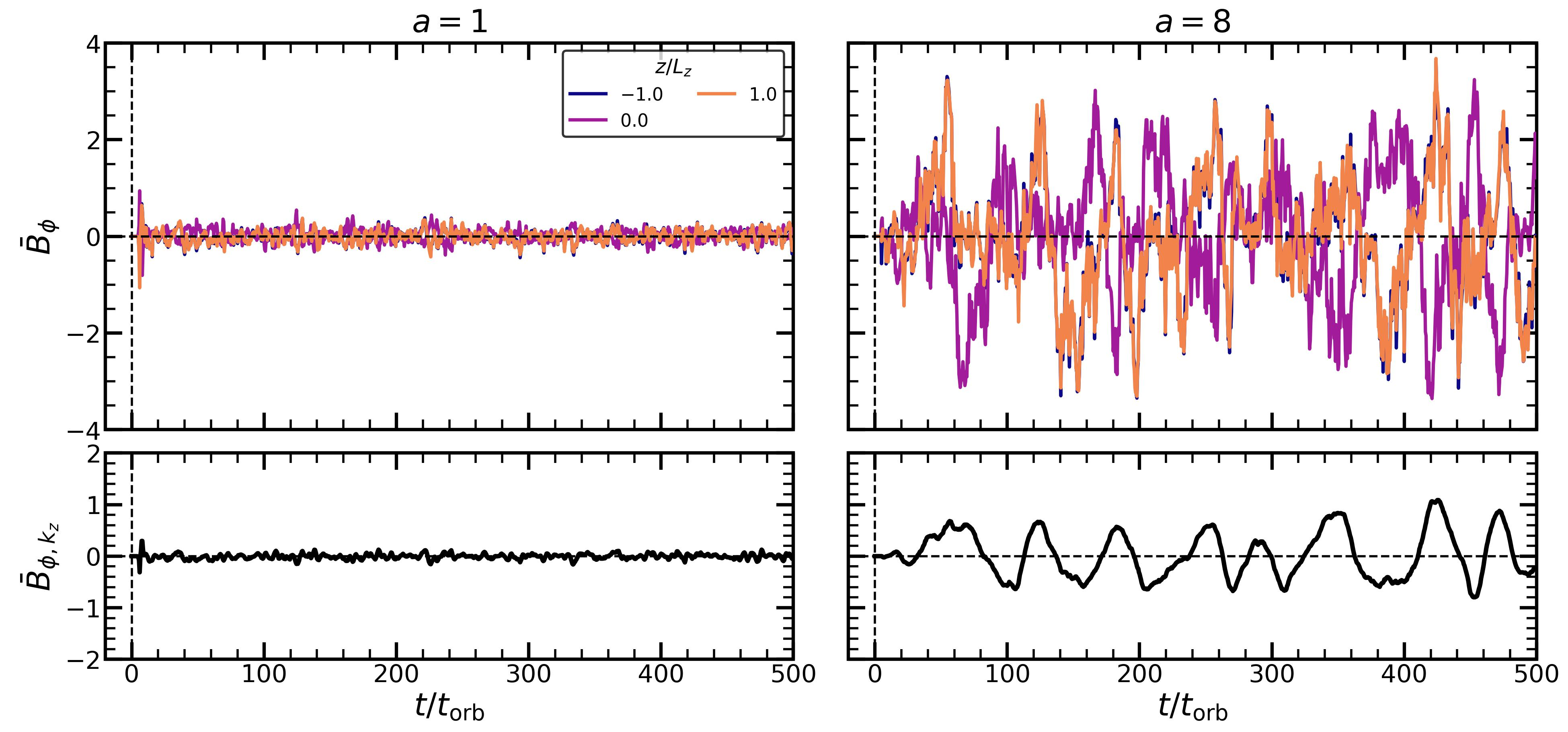
Two-column comparison of time-varying azimuthal magnetic fields in shearing-box simulations with aspect parameters a equals 1 and a equals 8
Why box geometry matters. My October 2026 dynamo-talk plot compares the azimuthal magnetic-field signal for two simulation aspect parameters.
KINETIC PLASMAS

How plasmas accelerate particles

Collective plasma dynamics can produce energetic particles beyond a simple thermal distribution.

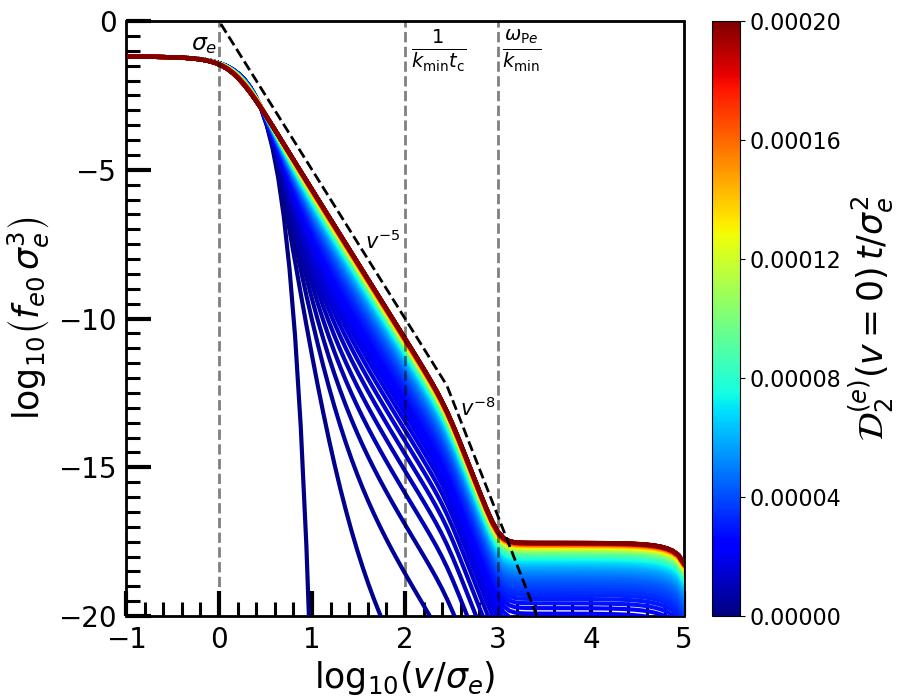
I study how collective interactions in collisionless and weakly collisional plasmas create non-thermal power-law tails, and how these processes help explain the inverted temperature profile in the solar corona.

Current manuscript figure showing the evolution of an electron velocity distribution from a Maxwellian toward non-thermal power-law tails
Electron distribution develops non-thermal power-law tails in the current kinetic-plasma manuscript.
MAGNETIZED PLASMAS · ONGOING MANUSCRIPT

How coherent magnetic fields affect particle acceleration

Electrons and protons respond very differently to the same turbulent electric field.

With Alexander Schekochihin, Robert Ewart, and Amitava Bhattacharjee, I am developing a self-consistent quasilinear theory of non-thermal acceleration in magnetized plasmas. It describes how dielectric screening, cyclotron resonances, and anisotropic scattering control the way each particle species gains energy. The manuscript is in preparation.

PLASMA RELAXATION · JOURNAL ARTICLE

What survives when a plasma relaxes?

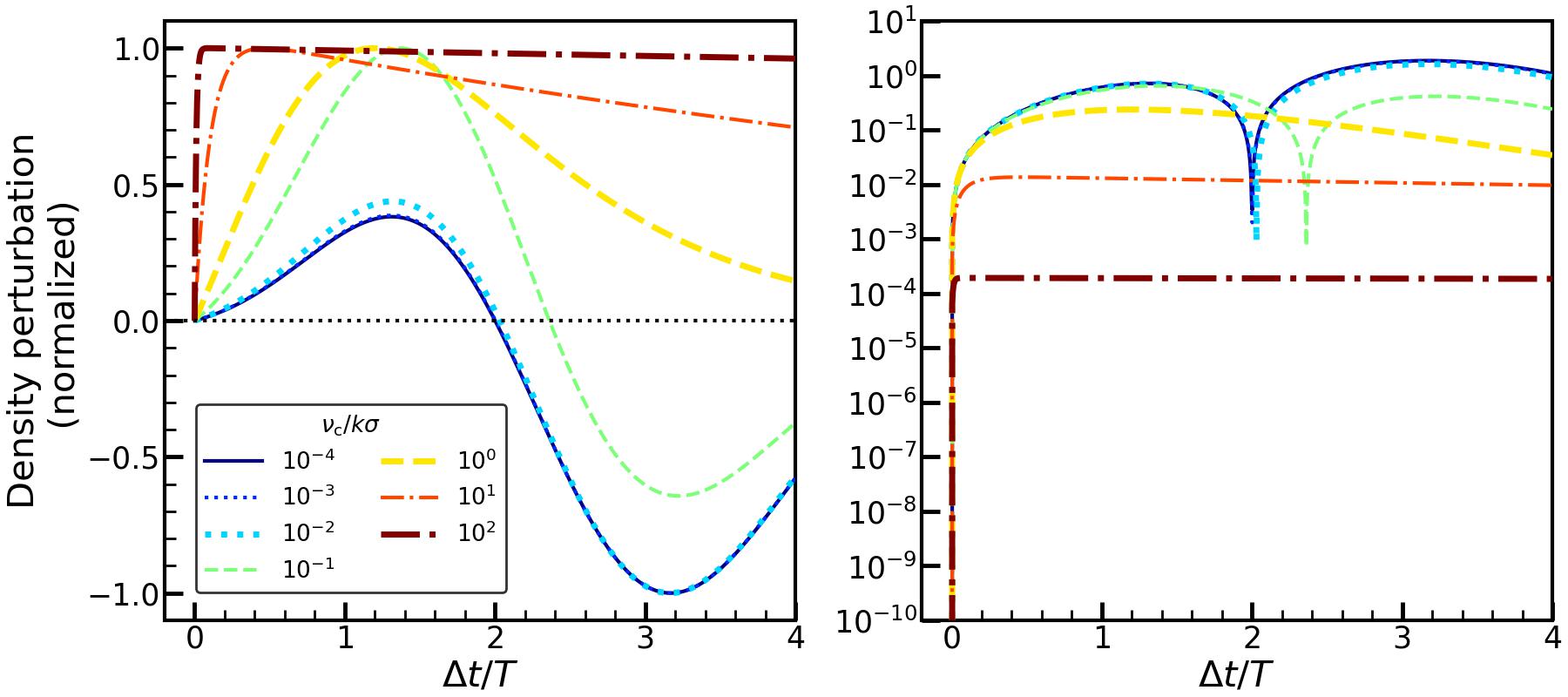
Weak collisions can change how plasma perturbations decay and whether an echo remains visible.

In work published in Physical Review E, Amitava Bhattacharjee and I examined continuous spectra, discrete modes, and the decay of the echo in weakly collisional plasmas.

Research plot comparing the amplitude and timing of plasma echoes for several collision rates
How the plasma echo decay rate changes with collision frequency.
DARK MATTER

How dark matter halos find their shape

Dark matter halos develop near-universal density profiles that are insensitive to initial conditions. Why?

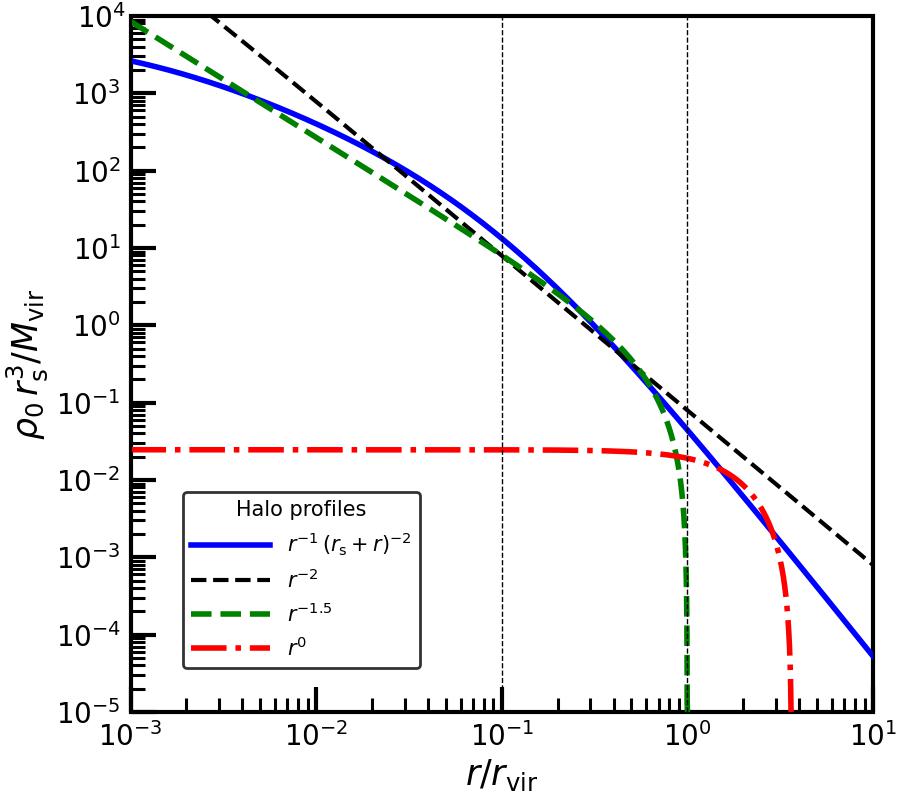
In my work on collisionless relaxation, I study how self-gravitating systems evolve toward quasi-steady configurations. This uses kinetic theory to shed light on the origin of the characteristic inner cusp and outer fall-off (the NFW profile) in cold dark matter halos.

Comparison of NFW, isothermal, cored, and r-to-the-minus-three-halves dark matter halo profiles
From the public quasilinear halo paper: comparison of the NFW profile, an isothermal sphere, a central core, and an r⁻³ᐟ² cusp.
DARK MATTER · SUBMITTED TO PHYSICAL REVIEW D

How violent relaxation generates universal halo profiles

Cosmic structure grows through collapse, accretion, and mergers. How can those messy histories lead to universal halo shapes?

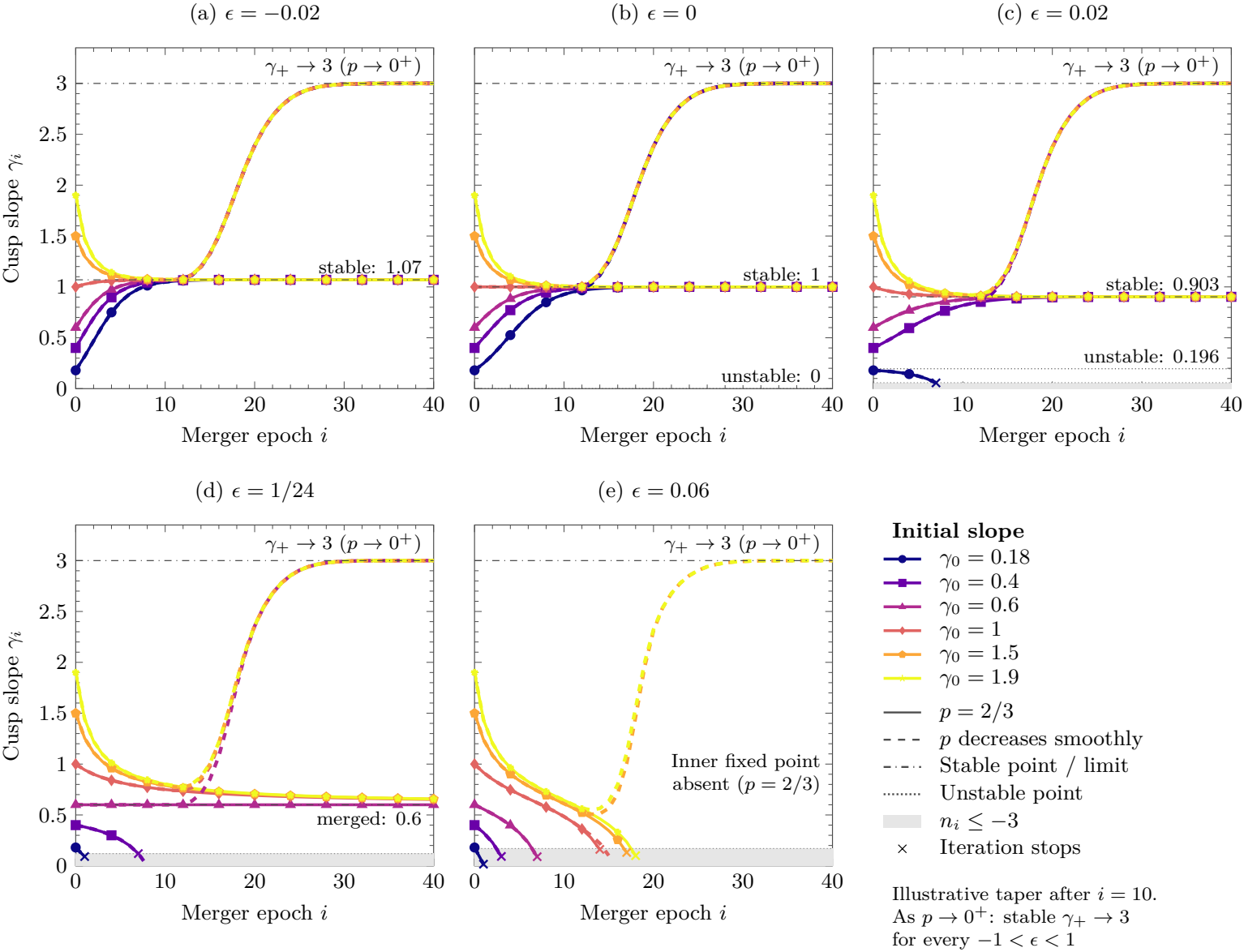
My ongoing Boltzmann–Poisson study develops a self-similar picture of cold dark matter halo assembly and relaxation. It shows how steep prompt cusps arise from the initial collapse and later accretion and substructure-mediated relaxation make the halo NFW-like. Its research context is discussed in a recorded Perimeter seminar.

Current manuscript figure showing five modeled cusp-slope trajectories across successive merger epochs
Five modeled cusp-slope trajectories from the current Boltzmann–Poisson manuscript.
QKIN / QUANTUM MANY-BODY PHYSICS · ONGOING RESEARCH

Non-thermal states in quantum many-body systems

A stationary many-body state can retain a non-thermal particle distribution.

An ongoing quantum kinetic project studies how one-particle occupations and pair correlations evolve together, and how many-body stationary states often remain non-thermal.

PHD RESEARCH · YALE

Galactic dynamics.

GALACTIC DYNAMICS

Phase spirals: a galaxy’s memory

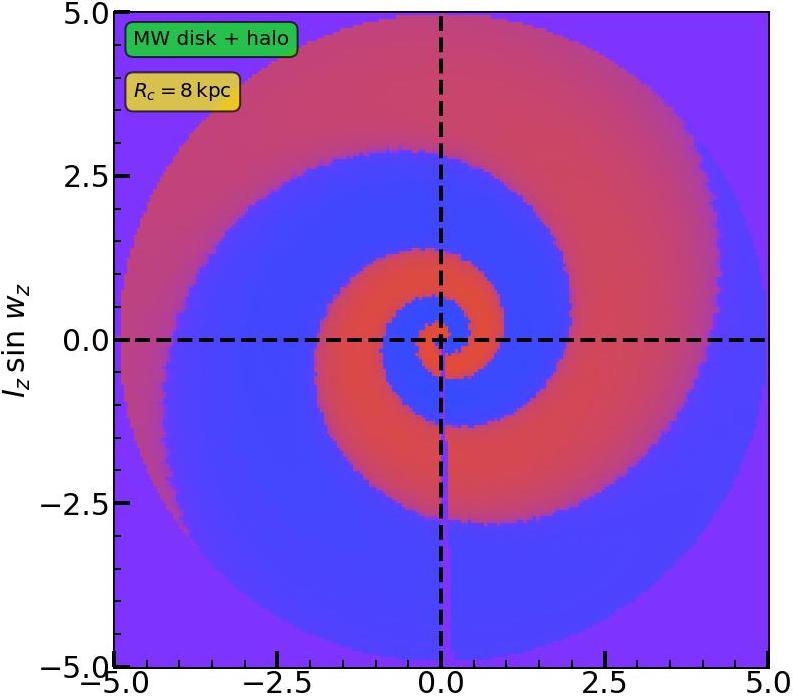
A disturbance can leave a winding pattern in the motion of stars in phase-space—an imprint that persists long after the event.

My work developed a perturbative framework for phase-mixing in stellar disks, first in an idealized slab and then in an inhomogeneous disk galaxy. The two studies connect the shape and evolution of phase spirals to the disk’s response to perturbations by satellite impacts.

One-armed phase spiral in the Milky Way disk and dark matter halo at a galactocentric radius of 8 kpc
One-armed phase spiral excited by the Sagittarius encounter in the Milky Way disk and halo at R = 8 kpc. From Banik, van den Bosch & Weinberg (2023).
GALACTIC DYNAMICS

When gravitational drag changes direction

A massive object perturbs stellar and dark-matter orbits; their collective gravitational response can slow its inward drift or push it outward in a shallow core.

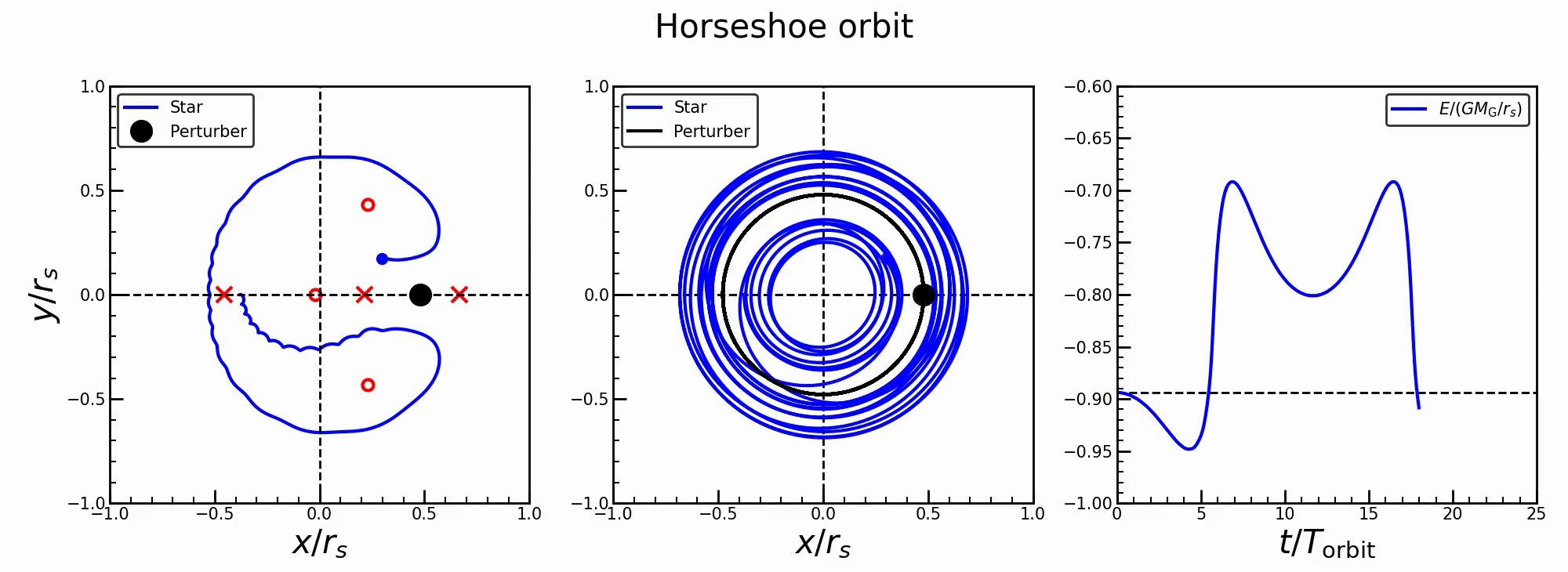
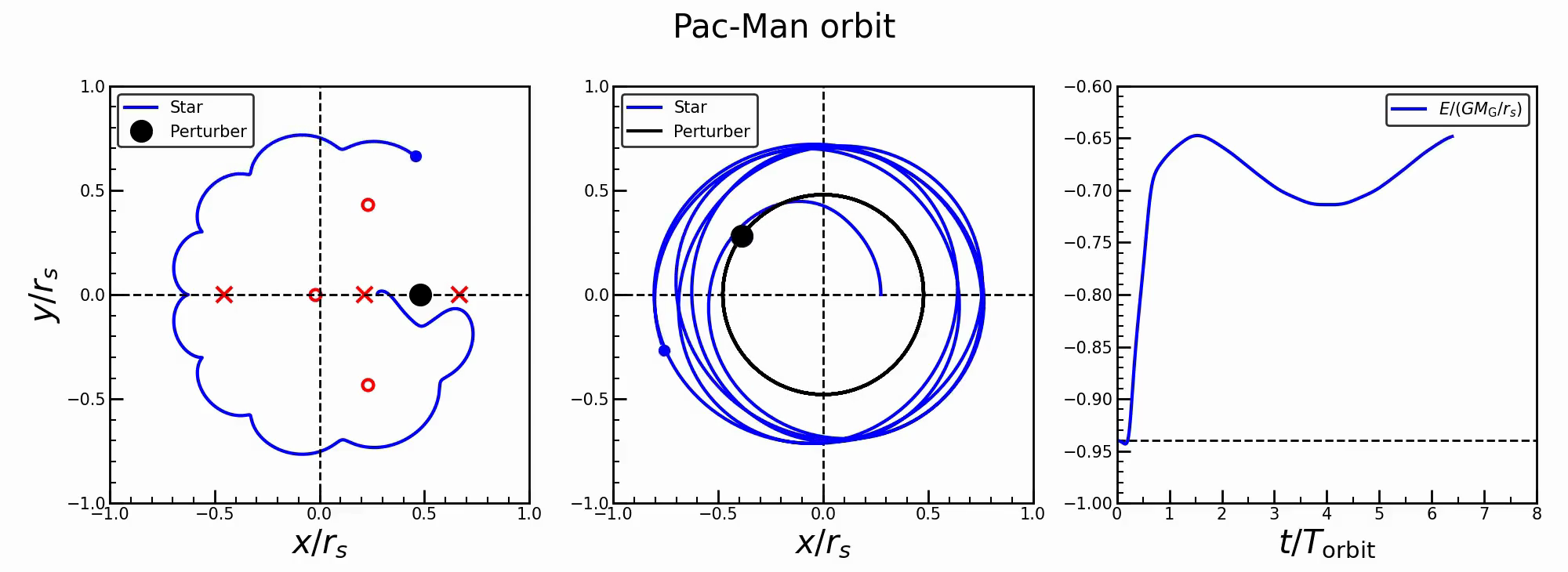
I studied the time-dependent gravitational response to a massive perturber, including dynamical friction, buoyancy, and core stalling. The work asks when an orbit sinks, stalls, or responds in a less intuitive way to the surrounding matter.

Horseshoe orbitIllustrative orbital motion around a perturber. View GIF ↗
Pac-Man orbitAnother orbital path in the same dynamical setting. View GIF ↗
GALAXY ENCOUNTERS · 2021 JOURNAL ARTICLE

When galaxies pass and stars respond

A rapid gravitational encounter can inject energy into an extended stellar system.

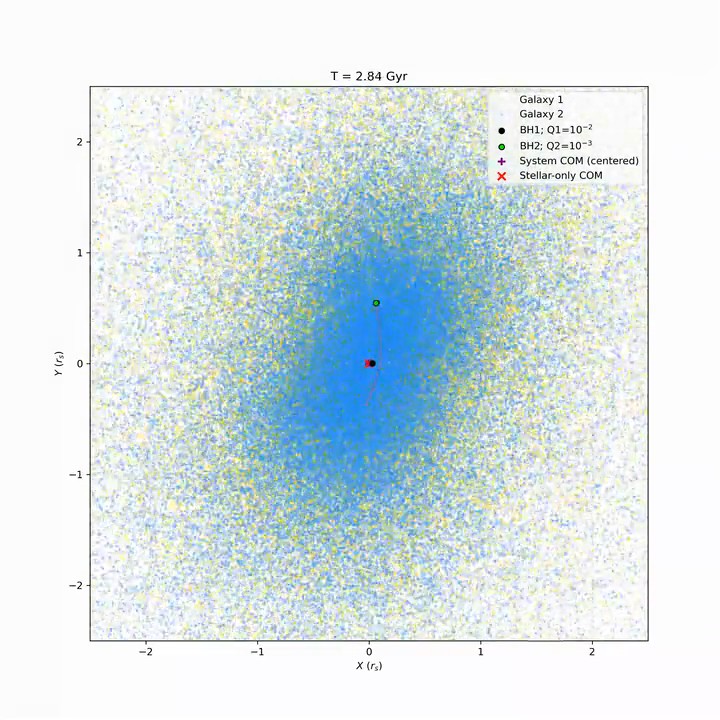
With Frank van den Bosch, I developed a theory of impulsive heating that accounts for the internal structure and trajectories of interacting galaxies. The archived simulation shown here follows two galaxies and their central black holes through a close encounter. The movie illustrates the dynamics of a close galaxy encounter.

Archived close-encounter simulation: yellow and blue trace two galaxies, while marked points track their central black holes. The sequence follows the simulated encounter.
GRAVITATIONAL LENSING · PUBLISHED WORK

Finding wandering black holes in a thin arc

A black hole passing near a gravitationally lensed arc can leave a tiny, recognizable kink.

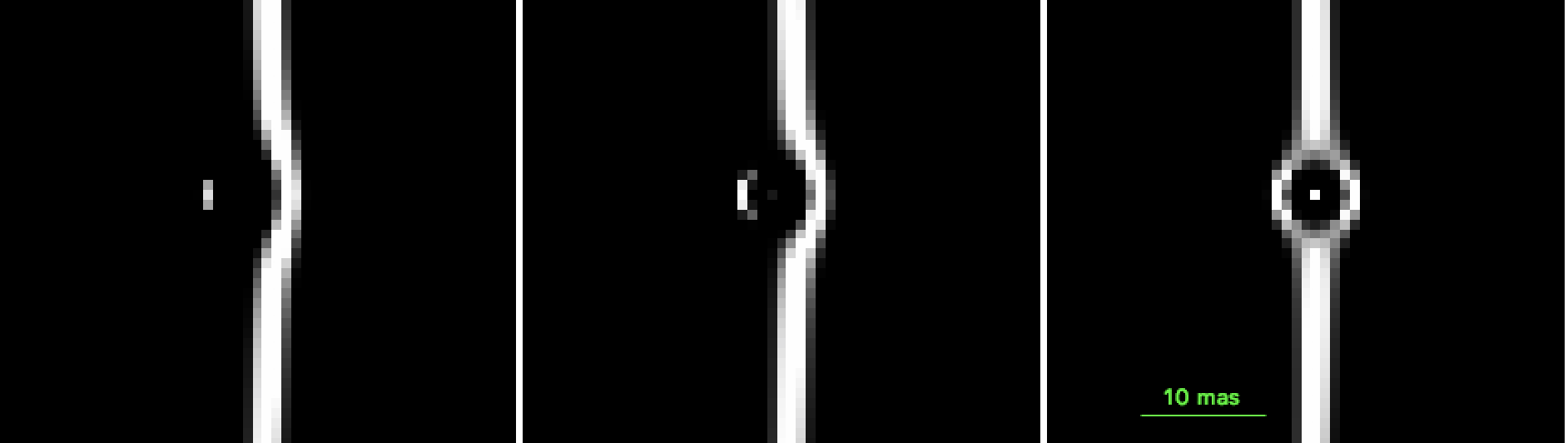
In collaborative PhD work, I studied how the shape of a razor-thin lensing arc could constrain a population of free-floating black holes. The image shows how a modeled black hole changes the arc as its position moves across the line of sight.

Three noiseless simulated white lensing arcs on black backgrounds; a black hole bends the center arc and creates a small ring in the right panel
Noiseless mock images from the published study: a 10⁶-solar-mass black hole distorts a thin gravitationally lensed arc at three impact parameters. The panels show simulated lensing arcs.
ALSO EXPLORED

Earlier foundations

Additional early work investigated self-gravitating fluid models of dark matter.

COLLABORATIONS & EARLY WORK

Other collaborations.

I have also contributed to projects in galactic structure and driven quantum systems.

GALACTIC DYNAMICS · 2026 JOURNAL ARTICLE

What controls dynamical friction in galactic cores?

With Shashank Dattathri, Frank van den Bosch, and collaborators, I studied how the phase-space structure of galactic cores shapes dynamical friction, stalling, and buoyancy.

Read the journal article ↗
GALACTIC STRUCTURE · 2025 JOURNAL ARTICLE

Why galaxies can become lopsided

A collaborative study led by Shashank Dattathri investigates the dipole instability as a route to lopsidedness and off-centered nuclei in gravitational systems.

Read the journal article ↗
QUANTUM DYNAMICS · 2018 JOURNAL ARTICLE

Driven quantum systems

An earlier collaboration with Utso Bhattacharya, Somnath Maity, and Amit Dutta studied exact results for Floquet coin-toss dynamics in integrable models.

Read the paper ↗
SOFTWARE

Codes & simulations.

VENUS / NUMERICAL SOLVER

Following matter as it evolves

VENUS stands for Vlasov–Einstein NUmerical Solver.

Developed by Uddipan Banik and Frank van den Bosch, it is a spherical kinetic-gravity codebase for studying self-gravitating matter. Its local research implementation spans Einstein–Vlasov, Vlasov–Poisson, Boltzmann–Poisson, weighted particle-in-cell, and spherical direct-simulation Monte Carlo calculations, with CPU and CUDA paths.

Animated density and slope plots for a collisionless dark matter halo calculation
Collisionless dark matter halo. A short preview shows the density profile and local slope evolving in a weighted particle-in-cell calculation. View the later, extended animation to t = 10,000 (24.7 MB) ↗ A still frame appears when reduced motion is preferred.
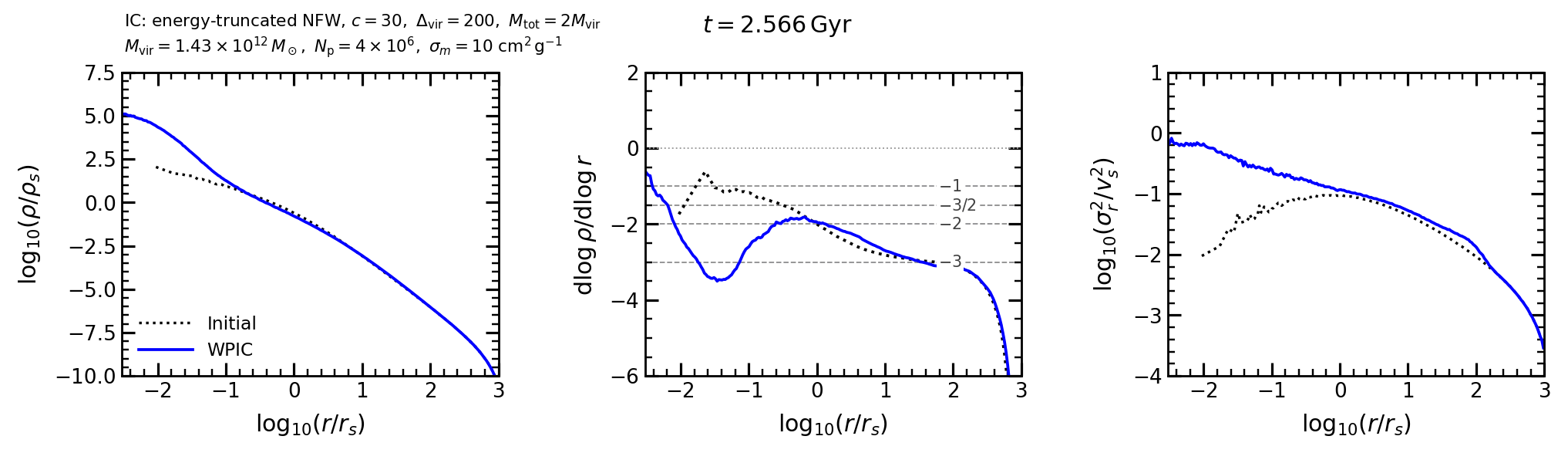
Animated density, slope, and velocity-dispersion plots of a self-interacting dark matter halo undergoing core collapse
Self-interacting dark matter. VENUS tracks core-collapse evolution in a spherical halo.
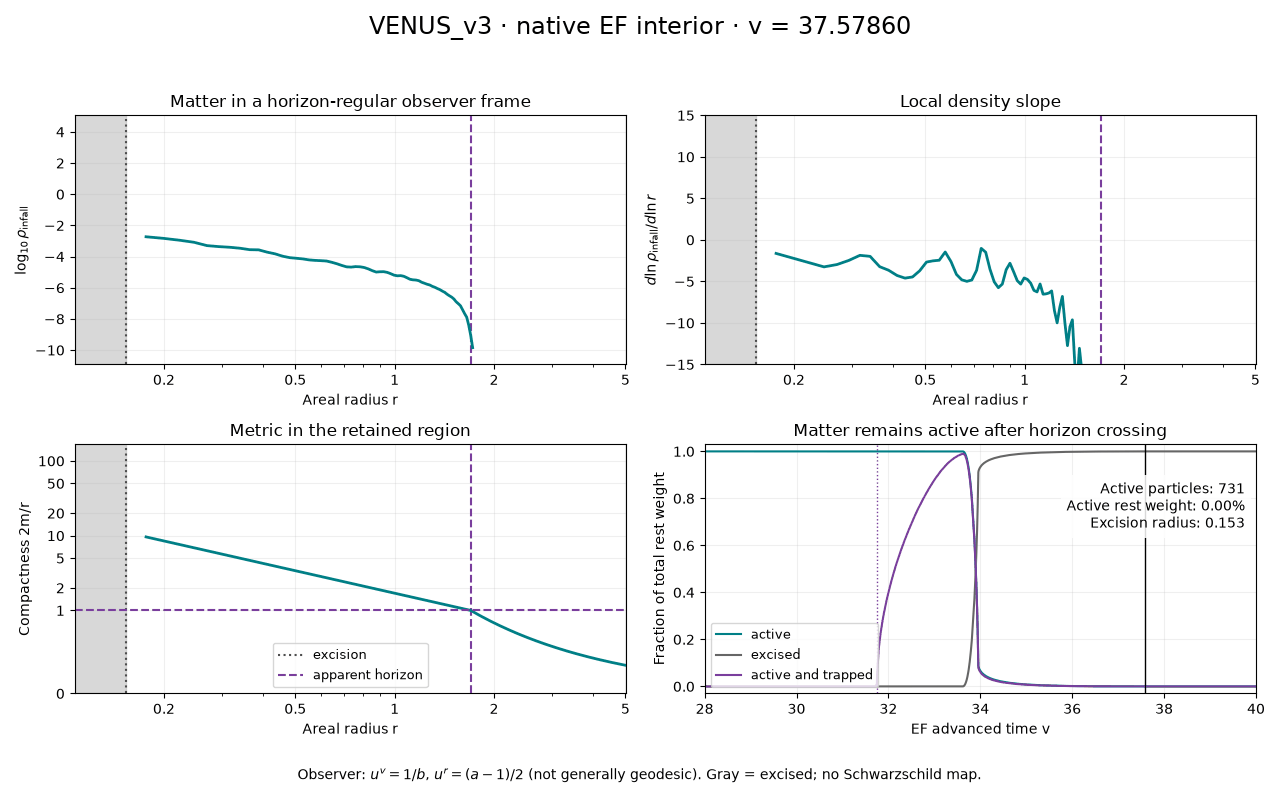
Animated density, local slope, compactness, and active matter in a VENUS black-hole formation calculation using a horizon-regular coordinate frame
Black-hole formation. A horizon-regular view follows matter through apparent-horizon formation and subsequent inner excision in a relativistic collapse calculation.

Stellar dynamo solvers for AthenaK and Athena++

I developed an anelastic MHD solver in AthenaK and Athena++ for stratified, shearing simulations and used it to simulate sustained magnetic reversals and meridional circulation. I am developing a fully compressible low-Mach MHD solver for stratified magnetoconvection.

QKIN

QKIN is a quantum kinetic solver for studying how weakly coupled bosonic and fermionic many-body systems approach thermal or non-thermal steady states.

NP-impulse

My public Python code computes non-perturbative energy transfer and mass loss in impulsive encounters of galaxies and dark matter halos. View the code ↗

Read the papers.

The publication list links to the papers and preprints discussed above.

Browse publications ↗Contact ↗